
FACILITY


  • Experimental Technique

    Wavefront sensing, Reflectivity, Ptychography, High energy resolution measurement (Mach-Zehnder interferometer), SR thermal power measurement, visible light measurement for mirror under thermal condition

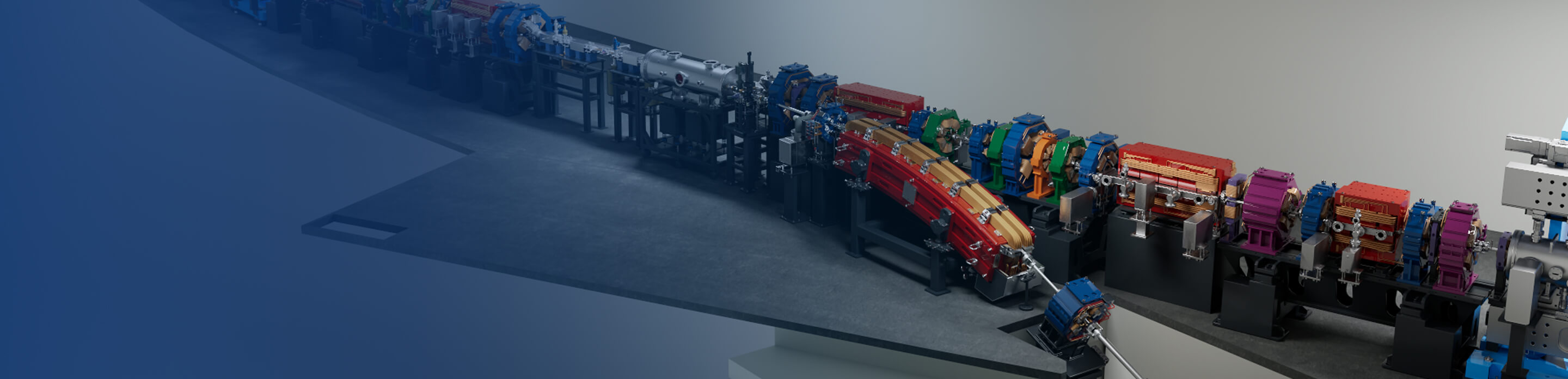
    The TEST beamline is dedicated to the in-house research for soft X-ray optics and SR instrumentation. It can also support detector calibration and early-stage tests for advanced experimental techniques. Currently, one of the beamline endstations supports a new experimental technique using ptychography for quantum materials research.


  • Beamline Optics

    Overview

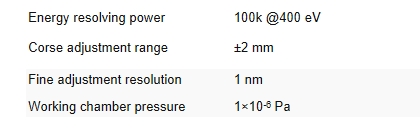
    The beamline is sourced by a linear polarization undulator (LPU38). It has two branches, namely, the mono beam branch and the white/pink beam branch. The mono beam branch uses the cPGM layout, has two gratings with energy resolving power of 100k @400 eV and 5k @ 867 eV. Endstation 3 at the end of the mono branch holds the Mach-Zehnder interferometer used to measure the ultra high-energy resolving power from the monochromator. It also supports the ptychographic characterization of quantum materials. The white/pink beam branch holds two endstations. One is for thermal management research on SR instrumentation, the other is for soft X-ray optics research. The beam directly from the source incident on the endstation for thermal management research. It then goes through a heat load chopper and two harmonic rejection mirrors before it reaches the endstation for X-ray optics research. The beam (ranging from 250 eV to 1000 eV) with the intrinsic bandwidth is used for this endstation. 


  • Experimental End-station

    Endstation for thermal management research

    Overview

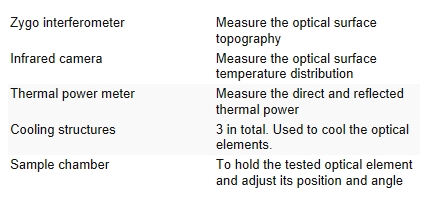
    The endstation for thermal management research aims to support the thermal management for the in-houses development of SR instrumentation. It provides various sensors and detectors to probe the behaviour of the optical element (mainly mirror) with the shine of white beam. Visible light interferometer is placed outside the chamber to detector the change of the surface topography, infrared camera is used to monitor the temperature on the optical surface. An in-house developed thermal power meter is also installed to measure the direct and reflected thermal power from the source.  

    Key Equipment

    Endstation for X-ray optics research

    Overview

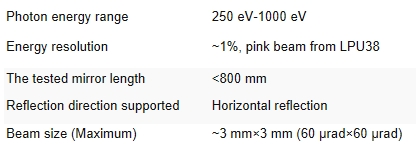
    The endstation for X-ray optics research receives the attenuated and filtered fundamental-energy beam for in-house soft X-ray optics research. The beam is attenuated by a heat load chopper. The harmonic rejection mirrors absorb the higher harmonic beam as well as attenuate the incident beam. The endstation works on the fundamental energy ranging from 250 eV to 1000 eV. The bandwidth is the intrinsic value (~1%) from the LPU38. 

    Key Parameters


    Mach-Zehnder interferometer

    Overview

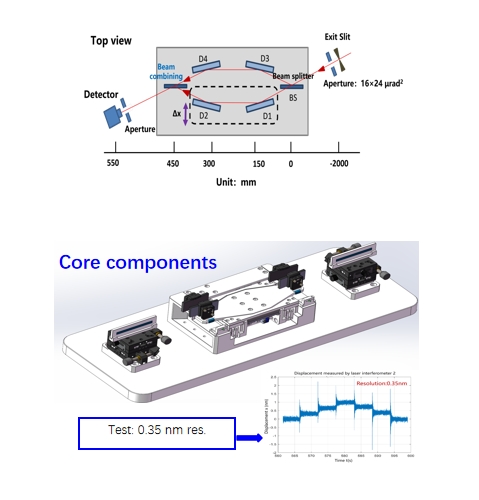
    The Mach-Zehnder interferometer is placed after the slit (~64 m) for the mono beam. Its main task is to measure the high energy resolving power from the grating monochromator. 

    Key Parameters


    Mono Beam Branch: Quantum Materials Imaging Beamline with Extreme Conditions


    Overview

    The Mono Beam Branch is an experimental endstation dedicated to in-situ imaging and manipulation studies of quantum materials. It employs techniques such as scanning coherent diffraction imaging and XPCS to investigate the evolution of nanoscale textures under continuously adjustable magnetic fields (0–1 T) and temperatures (0–300 K). The station is equipped with KB focusing mirrors and covers an energy range from 250 to 1500 eV, encompassing the absorption edges of key transition metal elements found in quantum materials. It achieves a spatial resolution between 8 and 20 nm.


  • Science

    Scientific Scope 1-1: The TEST beamline aims to support the in-house development of SR instrumentation. The endstation for thermal management research is built to investigate the cooling schemes for the optical elements. It can help to tackle the ever-increasing thermal problem when the storage ring goes to diffraction-limited. The endstation for X-ray optics research provides an experimental chamber to test the in-house developed instrument, such as the bending mirror. By combining the various wavefront sensing techniques, we can obtain the online and at-wavelength feedback for the test of the instrumentation. 

    Scientific Scope 1-2: The other focus for the TEST beamline is to support the research on soft X-ray optics. The endstation for X-ray optics research is dedicated to this. It provides an experimental chamber to develop the various wavefront sensing techniques. By using these techniques helps to devise all kinds of schemes for wavefront correction. The novel optics designed for advanced experimental methods can also be tested in this beamline.


    Scientific Scope 2-1: Spins give rise to diverse correlated states and topological orders; however, magnetic domain formation often suppresses macroscopic quantum effects. Emerging altermagnets combine the advantages of ferromagnets and antiferromagnets, offering new pathways toward device miniaturization and novel quantum states—though domain interference remains an obstacle for property analysis and device integration. Using techniques such as ptychography with in-situ magnetic fields, X-ray magnetic dichroism nanoimaging, and microstructural patterning, researchers can achieve nanoscale imaging of magnetic domains and controlled microstructure formation. These advances support applications in high-density magnetic storage and spin electronics, accelerating the transition of altermagnets from fundamental research to functional devices.

    Scientific Scope 2-2: The core goal of skyrmion imaging is to uncover the 3D evolution, multifield control, and room-temperature stability of topological spin structures using high-resolution multimodal microscopy, thereby supporting spintronic device design. Soft X-ray coherent diffraction imaging, combined with 3D vector reconstruction, achieves nanoscale resolution of coupled ferroelectric-magnetic topological states—such as room-temperature polar skyrmions in frustrated magnets—at sub-10 nm scales. In-situ magnetic fields are essential: they allow direct observation of skyrmion nucleation and annihilation, temperature-driven transitions to meron-antimeron pairs, and magnetic/current control over 3D skyrmion interactions. By integrating 3D X-ray imaging, high-field response, and in-situ multifield characterization, skyrmion research is advancing spintronics toward high-density storage, neuromorphic computing, and topological quantum devices.

    Scientific Scope 2-3: Coherent diffraction imaging enables non-destructive, nanoscale phase reconstruction for studying quantum materials such as moiré superlattices and Wigner crystals. It reveals defect and strain effects on quantum states—including superconductivity and topological phases—offering key insights into electron correlation phenomena. Unlike invasive methods like STM or TEM, this technique operates under near-equilibrium conditions with minimal perturbation, allowing precise in-situ visualization of electronic order during quantum phase transitions.

    Scientific Scope 2-4: Nanoscale electronic order reconstruction—including charge, spin, and nematic orders—plays a critical role in high-temperature superconductors by competing or cooperating with superconductivity at the domain level. In cuprate and nickelate systems, charge density waves (CDWs) form periodic modulations on the scale of 3–5 nm, often coexisting with superconductivity in stripe-like structures. Iron-based compounds such as NaFe₁₋ₓCoₓAs exhibit spin density wave (SDW) domains coupled atomically with superconducting regions, showing distinct energy gaps (~15 meV vs. ~8 meV). Nematic orders break rotational symmetry, forming anisotropic nanodomains observable via X-ray scattering and tunable via strain. These nanoscale reconstructions provide key insights into unconventional superconducting mechanisms and pathways for external quantum state control.


  • Useful Information

    Related beamlines:

    TEST beamlines:

    https://ssrf.sari.ac.cn/dkxzz/tbfs/gsxz_gb/xzdl_tbfs/bl09b/xzjs/

    https://english.ihep.cas.cn/heps/fa/bl/202112/t20211222_295080.html


FACILITY Test Beamline

Experimental Technique

Wavefront sensing, Reflectivity, Ptychography, High energy resolution measurement (Mach-Zehnder interferometer), SR thermal power measurement, visible light measurement for mirror under thermal condition

The TEST beamline is dedicated to the in-house research for soft X-ray optics and SR instrumentation. It can also support detector calibration and early-stage tests for advanced experimental techniques. Currently, one of the beamline endstations supports a new experimental technique using ptychography for quantum materials research.


Beamline optics

Overview

The beamline is sourced by a linear polarization undulator (LPU38). It has two branches, namely, the mono beam branch and the white/pink beam branch. The mono beam branch uses the cPGM layout, has two gratings with energy resolving power of 100k @400 eV and 5k @ 867 eV. Endstation 3 at the end of the mono branch holds the Mach-Zehnder interferometer used to measure the ultra high-energy resolving power from the monochromator. It also supports the ptychographic characterization of quantum materials. The white/pink beam branch holds two endstations. One is for thermal management research on SR instrumentation, the other is for soft X-ray optics research. The beam directly from the source incident on the endstation for thermal management research. It then goes through a heat load chopper and two harmonic rejection mirrors before it reaches the endstation for X-ray optics research. The beam (ranging from 250 eV to 1000 eV) with the intrinsic bandwidth is used for this endstation. 


Endstation for thermal management research

Overview

The endstation for thermal management research aims to support the thermal management for the in-houses development of SR instrumentation. It provides various sensors and detectors to probe the behaviour of the optical element (mainly mirror) with the shine of white beam. Visible light interferometer is placed outside the chamber to detector the change of the surface topography, infrared camera is used to monitor the temperature on the optical surface. An in-house developed thermal power meter is also installed to measure the direct and reflected thermal power from the source.  

Key Equipment
Endstation for X-ray optics research

Overview

The endstation for X-ray optics research receives the attenuated and filtered fundamental-energy beam for in-house soft X-ray optics research. The beam is attenuated by a heat load chopper. The harmonic rejection mirrors absorb the higher harmonic beam as well as attenuate the incident beam. The endstation works on the fundamental energy ranging from 250 eV to 1000 eV. The bandwidth is the intrinsic value (~1%) from the LPU38. 

Key Parameters

Mach-Zehnder interferometer
Overview

The Mach-Zehnder interferometer is placed after the slit (~64 m) for the mono beam. Its main task is to measure the high energy resolving power from the grating monochromator. 

Key Parameters

Science

Scientific Scope 1: The TEST beamline aims to support the in-house development of SR instrumentation. The endstation for thermal management research is built to investigate the cooling schemes for the optical elements. It can help to tackle the ever-increasing thermal problem when the storage ring goes to diffraction-limited. The endstation for X-ray optics research provides an experimental chamber to test the in-house developed instrument, such as the bending mirror. By combining the various wavefront sensing techniques, we can obtain the online and at-wavelength feedback for the test of the instrumentation. 

Scientific Scope 2: The other focus for the TEST beamline is to support the research on soft X-ray optics. The endstation for X-ray optics research is dedicated to this. It provides an experimental chamber to develop the various wavefront sensing techniques. By using these techniques helps to devise all kinds of schemes for wavefront correction. The novel optics designed for advanced experimental methods can also be tested in this beamline.


People

Useful Link

Related beamlines:

TEST beamlines:

https://ssrf.sari.ac.cn/dkxzz/tbfs/gsxz_gb/xzdl_tbfs/bl09b/xzjs/

https://english.ihep.cas.cn/heps/fa/bl/202112/t20211222_295080.html