


University of Science and Technology of China (USTC) has made important progress in the research of oxide spintronics
Ferromagnetic insulators (FMIs) are quantum materials with both ferromagnetic order and insulating properties, offering unique advantages in spintronics: ferromagnetism provides stable spin polarization, while insulation avoids Joule heat loss, making them key for low-power devices. However, natural FMIs are unknown, and artificial room-temperature FMIs are extremely rare—especially in transition metal oxides, where strong electron correlations, multi-orbital coupling, and interface effects make room-temperature stable FMI states a long-standing global challenge.
A University of Science and Technology of China (USTC) team used interface engineering and orientation control to design 3d/5d transition metal oxide heterostructures. In (111)-oriented SrIrO₃/La₂/₃Sr₁/₃MnO₃ (SIO/LSMO) superlattices, they first discovered a room-temperature ferromagnetic insulating state induced by interfacial enhanced spin-orbit coupling (SOC). This overcomes the metallic state of LSMO’s double exchange mechanism and first observes a broad-temperature ferromagnetic insulating phase during its ferromagnetic metal-to-paramagnetic insulator transition. The finding breaks the classic view of LSMO (since its 1950s discovery) that "ferromagnetism must accompany metallicity" and provides a new material platform for next-gen spintronic devices. Results were published in Physical Review Letters under the title "Interfacial Spin–Orbit Coupling Induced Room-Temperature Ferromagnetic Insulator."
Using their self-built pulsed laser deposition system, the team grew SIO/LSMO superlattices with sharp atomic-level interfaces. Magnetotransport measurements showed stable ferromagnetic insulating behavior near 300 K, and X-ray magnetic circular dichroism (XMCD) further verified room-temperature ferromagnetism originates from LSMO’s double exchange interaction. DFT first-principles calculations revealed significantly suppressed charge transfer at (111)-oriented interfaces, indicating insulation isn’t from direct electron exchange between SIO and LSMO. Integrating experiments and theory, they proposed: At (111) interfaces, strong SOC couples with polarons in LSMO, enhancing electron-phonon interactions, reducing carrier mean free path, and inducing insulation. This mechanism offers a new physical picture and theoretical framework for understanding ferromagnetic insulator (FMI) formation and room-temperature stability.
Yuhao Hong, a PhD graduate of 2025 from the NSRL of the (USTC) (currently a postdoctoral researcher at the Technical University of Denmark), is the sole first author of this paper. Professor Zhaoliang Liao, Researcher Kai Chen, Associate Researcher Yulin Gan, and Professor Liang Si from Northwestern University are co-corresponding authors.
The above research was supported by valuable beamtime from the Hefei Light Source (NSRL) and the Deimos beamline of the French synchrotron radiation facility Soleil, as well as funding from the Key Research Program of the Ministry of Science and Technology and the National Natural Science Foundation of China (NSFC).
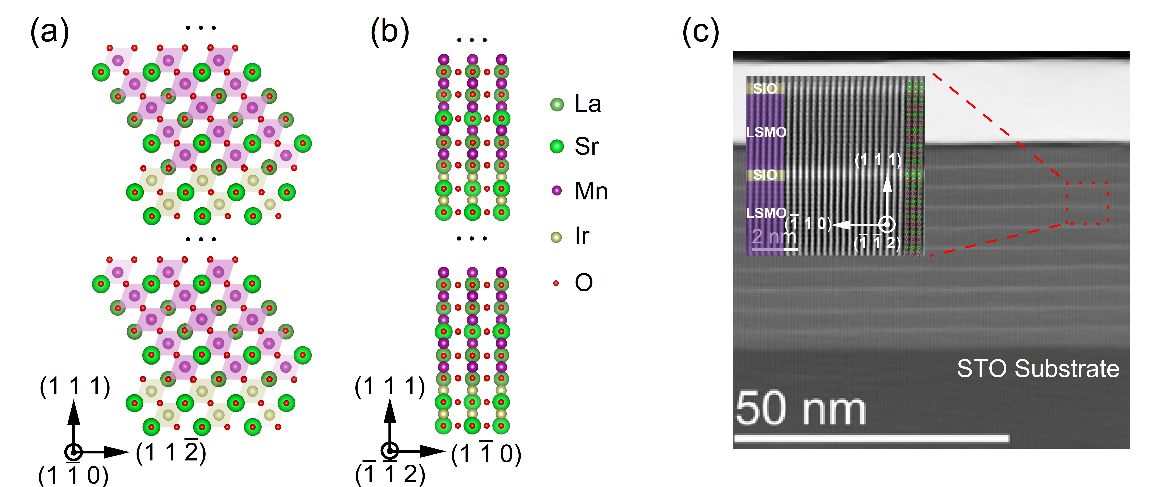
Fig. 1: Atomic-level superlattice interface
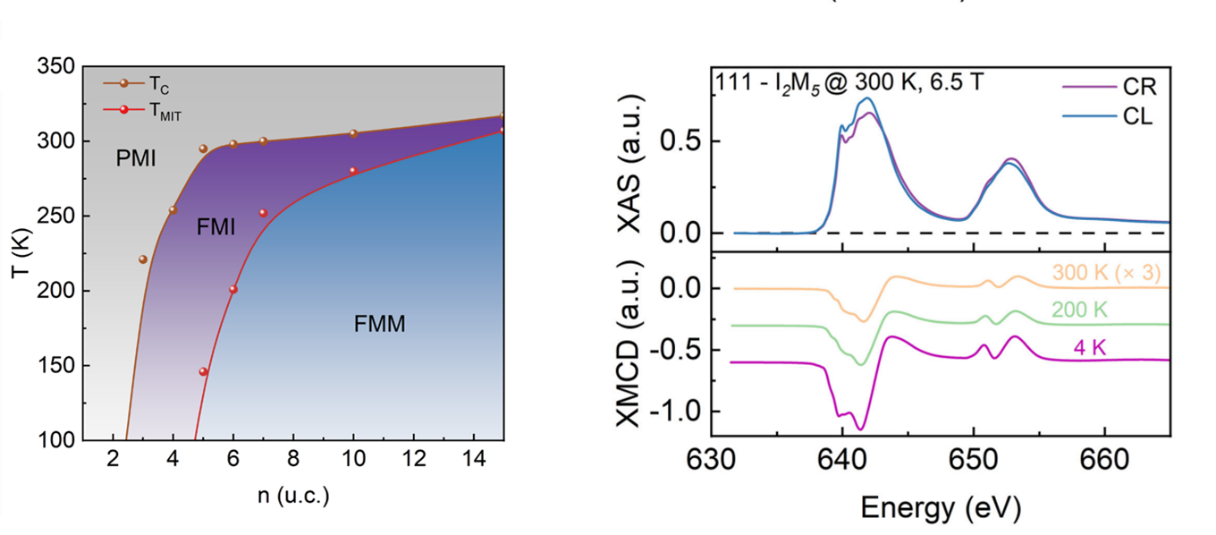
Fig. 2. FMI over a wide temperature range during the transition from the FM to the PMI phase of LSMO, and XMCD spectra at different temperatures.
Back