


X-ray 3D Nano CT Reveals Inner Workings of High-Performance Lithium-Sulfur Batteries
In a significant advance for next-generation energy storage, a research team led by Professor Yingze Song at the State Key Laboratory of Environment-Friendly Energy Materials, Southwest University of Science and Technology, has developed a novel electrode structure for lithium-sulfur (Li||S) batteries. Their work, published in Nature Communications, introduces a gamma-ray irradiated polyacrylamide (I-PAM) binder that effectively tackles the persistent challenge of structural degradation in sulfur cathodes caused by volume expansion and contraction during charge-discharge cycles.
The innovative application of the I-PAM binder allows the sulfur electrode to maintain exceptional structural integrity, significantly suppressing volume changes. This breakthrough enables Li||S pouch cells to deliver outstanding discharge capacity and cycling stability even under demanding conditions, including folding and extreme temperatures. This advancement not only significantly enhances the practical performance of lithium-sulfur batteries but also provides a new design strategy for high-energy-density battery systems, paving the way for their commercialization in applications such as electric vehicles and portable electronics.
The Critical Role of X-ray 3D Nano CT
A cornerstone of this research was the use of advanced characterization techniques to understand how the I-PAM binder achieves its remarkable effects. Synchrotron radiation X-ray 3D nano computed tomography (nano CT) played a pivotal role, enabling the team to directly visualize and quantify the sulfur electrode’s microstructural evolution during cycling for the first time.
Conducted at the BL07W beamline of the Hefei National Synchrotron Radiation Laboratory, this technique provided a powerful combination of high photon flux (2 × 10¹⁰ photons per second) and exceptional spatial resolution (30 nm). This allowed the researchers to precisely monitor structural changes within the electrode over multiple charge-discharge cycles.
Through X-ray 3D nano CT, the team obtained direct evidence of how the I-PAM binder functions within the electrode network. The high-resolution 3D reconstructions revealed that the binder network guides the rational regeneration and reoccupation of sulfur species during cycling. This directly validated the binder’s effectiveness in mitigating volume change effects and preserving the cathode’s structural integrity, confirming the mechanism that underpins the battery’s superior performance.
This detailed structural analysis, combined with small-angle X-ray scattering (SAXS) and virtual simulations, provided a comprehensive, multi-scale understanding of the I-PAM binder’s mechanism of action. The insights gained from X-ray 3D nano CT were crucial, providing the direct evidence needed to precisely guide the rational design of advanced binders, demonstrating that such sophisticated characterization is essential for the development of next-generation, high-performance energy storage systems.
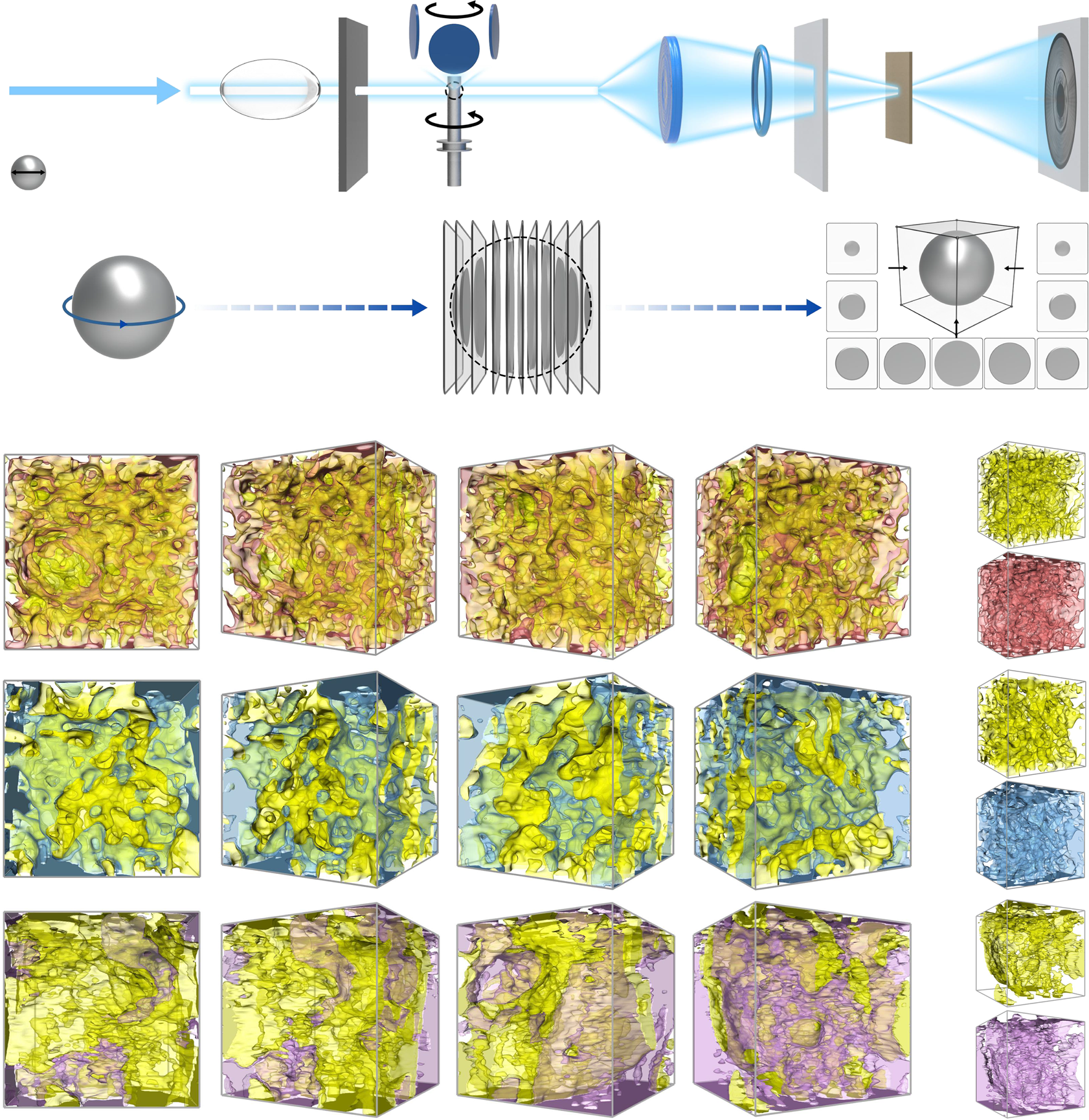
Figure 1 (a) Schematic diagram of the soft X-ray imaging principle; (b) Synchrotron radiation X-ray three-dimensional nano-imaging results of FP in the LFP substrate at different rotation angles.
This work is published in Nature Communications under the title “γ-Ray irradiated polyacrylamide networks enable high-performance Li||S pouch cells.”
Full article: https://doi.org/10.1038/s41467-025-61942-4
Back