


USTC Team Achieves New Breakthrough in AI-Driven Radiation Protection
In a notable advancement for AI-enabled radiation protection, a research team led by Shiping Jiang at the National Synchrotron Radiation Laboratory of the University of Science and Technology of China (USTC) has developed a three-dimensional radiation field reconstruction framework for synchrotron radiation facilities. By integrating high-fidelity Monte Carlo simulations with artificial intelligence, the method enables accurate 3D reconstruction of dose distributions within a storage ring hall under extremely sparse sampling conditions. The framework has also been preliminarily validated using measurement data from the Hefei Light Source (HLS), demonstrating its potential for practical deployment in real facility environments.
The study was published in Radiation Measurements on March 14, 2026, titled“AI-based three-dimensional radiation field reconstruction for synchrotron radiation facilities”.
During the operation of large-scale radiation facilities such as synchrotron light sources, lost particles interact with equipment components and surrounding materials, generating complex mixed radiation fields dominated by neutrons and photons. These fields are highly nonuniform in space and dynamic over time. Accurate monitoring of such radiation environments is essential for ensuring personnel safety. However, conventional monitoring systems rely on a limited number of fixed detectors, making it difficult to fully characterize the spatial distribution of these complex radiation fields. This limitation has created a strong demand for AI-based 3D reconstruction methods from sparse monitoring data.
To address this challenge, the team used the HLS storage ring hall as a case study. They employed Monte Carlo simulations to generate more than 100 reference radiation field samples representing typical radiation distributions at HLS under various operational conditions. These simulations yielded a high-fidelity 3D radiation field dataset for model training and testing. Based on this dataset, they developed a 3D U-Net++ network, a convolutional encoder-decoder model with nested skip connections that is well suited for reconstructing 3D radiation fields from extremely sparse sampling. Using dose data from a limited number of fixed monitoring points, along with randomly sampled points, the model can reconstruct the radiation field across the storage ring hall with high accuracy. Even when the number of sampling points is below 30, the network can still recover the spatial structure of the radiation field, demonstrating both high reconstruction accuracy and strong robustness under sparse sampling conditions.
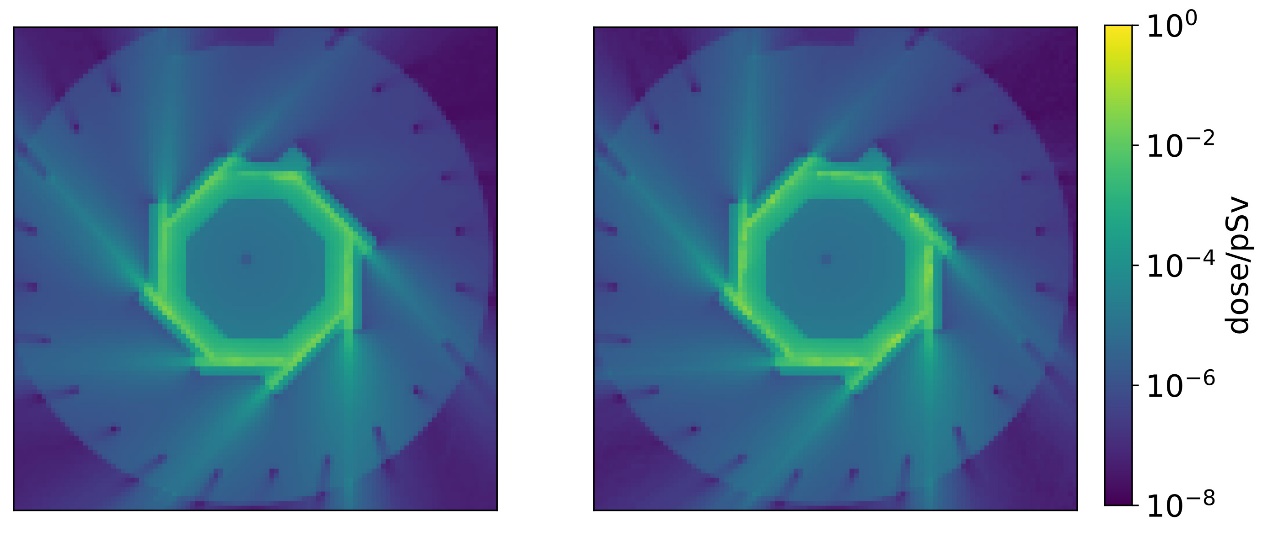
Figure 1. Comparison between the reconstructed radiation field in the beam plane under extremely sparse sampling (left) and the original dose distribution (right).
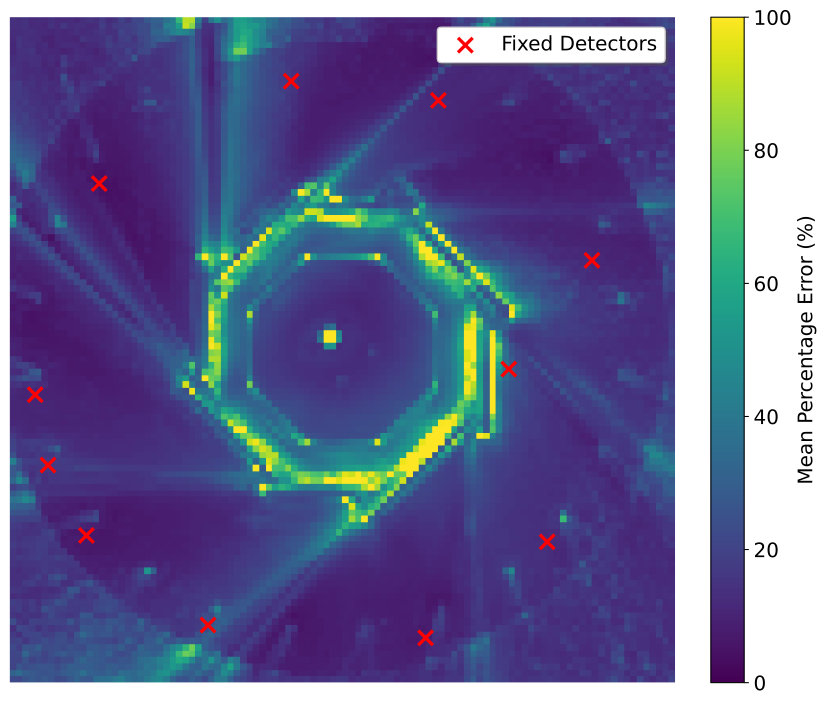
Figure 2. Distribution of the mean absolute percentage error (MAPE) for beam-plane radiation field reconstruction in the validation set.
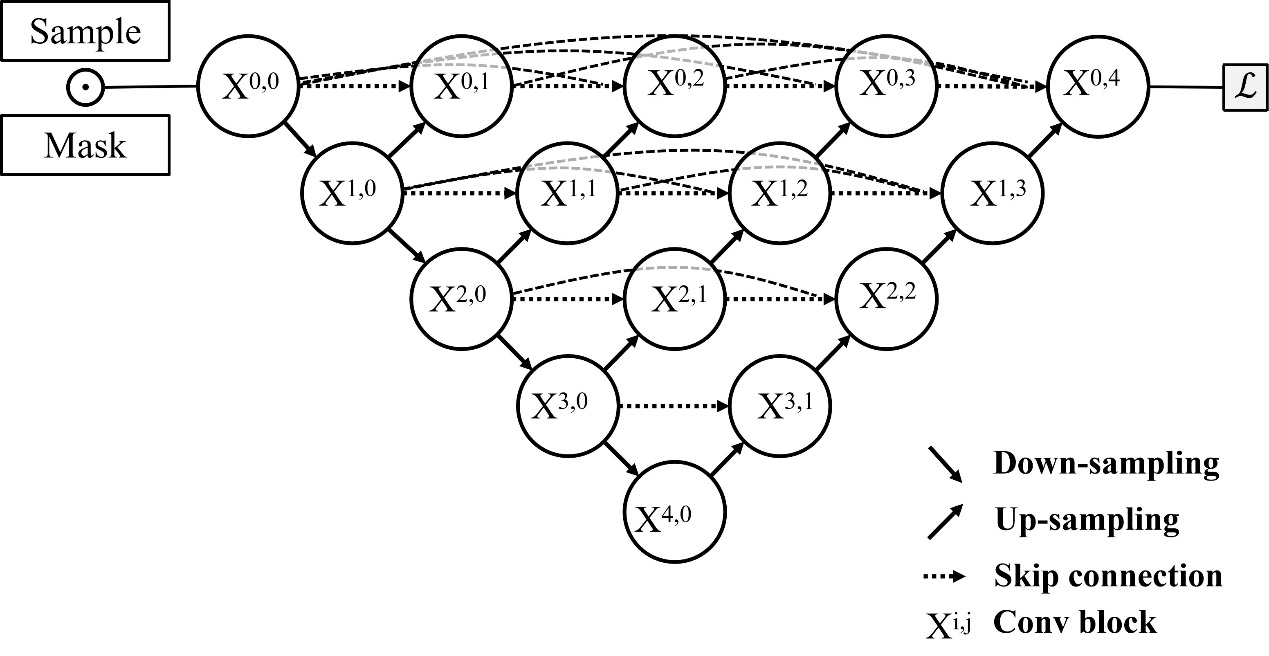
Figure 3. Architecture of the 3D U-Net++ network designed for extremely sparse sampling.
To further assess the method under real operational conditions, the team deployed optically stimulated luminescence dosimeters (OSLDs) in the HLS storage ring hall and conducted cumulative dose measurements over a two-month period. The measured doses were then compared with the model predictions. The good agreement between measurement and prediction indicates that the method can effectively characterize the actual radiation field distribution, confirming its reliability and practical feasibility in a real facility setting.
This study is the first to apply neural network methods to 3D radiation field reconstruction for synchrotron radiation facilities and to validate the approach using measurement data from an operating facility. The work offers a promising route to overcoming the limitations of conventional radiation monitoring systems in characterizing nonuniform and time-varying radiation fields. It also lays the groundwork for future intelligent radiation monitoring systems with full spatial coverage, high resolution, and real-time capability.
The first author of the work is Jiaduo Chen, a doctoral student at the National Synchrotron Radiation Laboratory of USTC, and the corresponding author is Shiping Jiang.
Publication link: https://doi.org/10.1016/j.radmeas.2026.107676
Back